
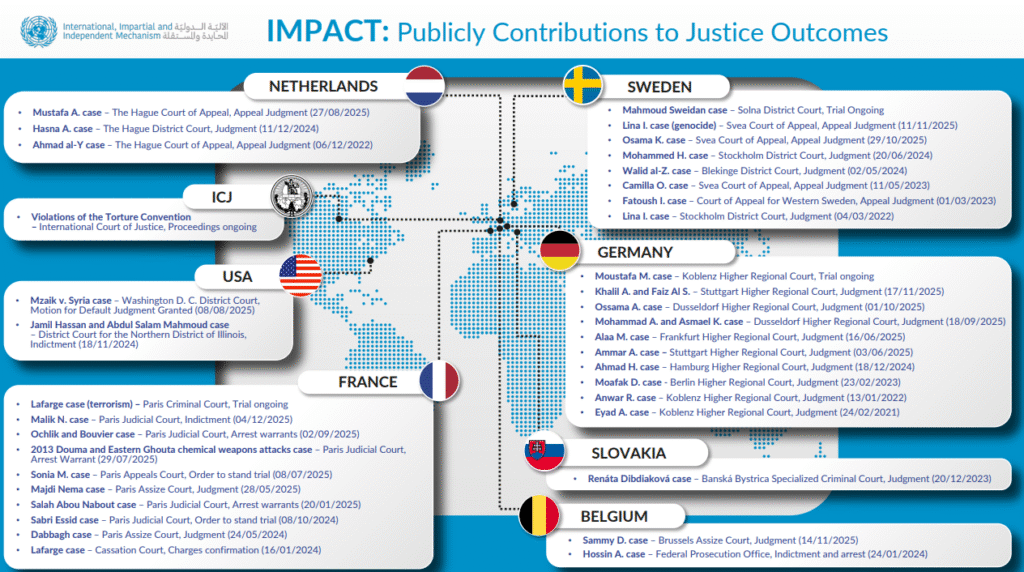
To view the map in a separate tab click here
Message from the Head of the IIIM
A Year of Transition. A Commitment to Justice.
Geneva, 8 December 2025
One year after the historic events of December 8, 2024, Syria is in a markedly different place. The fall of Assad’s regime opened space for justice efforts that were long obstructed.
Over the past year, we have intensified efforts to preserve, consolidate and analyse information that is central to current and future proceedings. Our central repository of information and evidence continues to grow, strengthening the foundation needed to move comprehensive accountability forward.
Since the start of our work, we have supported 256 investigations and received more than 530 requests for assistance from jurisdictions worldwide.
The establishment this year of Syria’s National Commissions for Transitional Justice and Missing Persons marks a significant and welcome development, although many crucial questions remain about the shape and scope of transitional justice in Syria. Through our engagement with the Commissioners in Damascus and Geneva, we follow their emerging priorities and stand ready to offer technical assistance and expertise. Discussions with the Syrian authorities are ongoing to determine how we can best support their work to help define and deliver justice for Syria.
For the IIIM, our responsibility remains the same: to help ensure that those responsible for the gravest crimes committed in Syria are held to account. Syria’s tireless civil society organizations and victim and survivor associations continue to inspire and guide our work. Their documentation, insights and advocacy remain essential to ensuring that accountability responds to the harms they and countless others have endured.
There are of course, numerous challenges facing Syria, including building the trust of the Syrian people through fair and effective justice responses to crimes committed since December 8.
However, the opportunities before us today did not exist a year ago. Turning them into concrete outcomes will require sustained commitment and cooperation from all actors, Syrian and international alike.
My team and I will continue to deliver on the IIIM mandate, providing assistance to jurisdictions investigating and prosecuting those suspected of international crimes committed since 2011. We are also ready to support Syrians as they shape and advance their own transitional justice processes.
This first anniversary is a milestone in a journey that will span years. However, for justice to endure, it must be inclusive and grounded in meticulous evidence and due process, with meaningful participation of victims and survivors. Accomplishing that will take time, trust and cooperation, but it is an objective that is now achievable. My team and I feel privileged to be part of the journey.
Thank you for your continued support.
Robert Petit
Head, International, Impartial and Independent Mechanism
The IIIM Impact in Numbers
| 2024 | December 2025 | |
| Evidence properties registered and preserved | 900 | 1,000+ |
| Overall number of requests for assistance from jurisdictions worldwide | 426 | 539 |
| New requests for assistance received | 100 | 113 |
| Investigations supported | 215 | 257 |
| Overall number of requests for assistance supported | 303 | 385 |
| IIIM Analytical Products shared with jurisdictions | 48 products shared 217 times | 49 products shared 227 times |
| Overall number of activities of sharing information and evidence | 757 | 938 |
| Activities of sharing of information to clarify the fate of the missing | 4 | 7 |
| Cooperation frameworks | 89, including 66 with civil society organizations | 108, including 72 with civil society organizations |
Recent Activities
ECCHR side event at the Assembly of States Parties of the ICC
Sponsored by the Netherlands, Denmark and Liechtenstein, Head of the IIIM, Robert Petit, participated in a panel on accountability and cooperation mechanisms, alongside Syrian civil society representatives who stressed the urgent need for a legal framework enabling prosecution of international crimes. Mr. Petit noted the IIIM had the expertise and that “coordination with CSOs, UN bodies, and national courts is essential to avoid duplication and ensure accountability”.
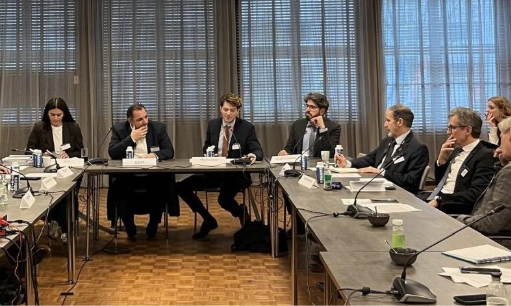
Also, at the ICC Assembly of States Parties, IIIM Deputy Head, Michelle Jarvis, participated in a panel focused on transformative justice for Syria organised by the Syria Forum, Legal Action Worldwide and the United Kingdom. Ms. Jarvis, along with panelists from the Syrian Transitional Justice Commission, Syrian Civil Society and Legal Action Worldwide reflected on the preliminary results of Legal Action Worldwide’s survey on Syrians’ perceptions of justice, showing that Syrians overwhelmingly want a justice process that not only punishes the perpetrators, but also leads to transformation of the systems that enabled violence and division.
Meeting on integration of accountability for conflict related sexual violence (CRSV) into transitional justice
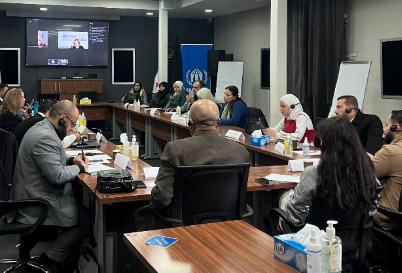
IIIM Deputy Head, Michelle Jarvis, spoke at a meeting in Damascus organized by the UN Team of Experts on the Rule of Law and Sexual Violence in Conflict (TOE) and the Syrian authorities. Ms. Jarvis was invited to present on the IIIM’s Gender Strategy and its Victim/Survivor Centred Approach, which was described as ‘pioneering practice’. Ms. Jarvis provided detailed examples of the IIIM’s innovative framework to proactively integrate gender category crimes into all aspects of its international justice and accountability processes.
Genocide Prosecution Network
The IIIM Head, together with senior staff, attended the 38th meeting of the European Network for investigation and prosecution of genocide, crimes against humanity and war crimes hosted at Eurojust. The meeting of around 150 practitioners from national authorities, international accountability mechanisms and civil society examined how new technologies are reshaping investigations and prosecutions of core international crimes.
Discussions focused on the use of open-source information (OSI), satellite imagery and 3D modelling to document and investigate large-scale atrocities, including challenges related to authentication, reliability and managing large volumes of digital evidence.
Participants also explored the opportunities and legal/ethical considerations associated with artificial intelligence and machine learning, including for identifying and analysing crime patterns.

EU Day of Dialogue Conference
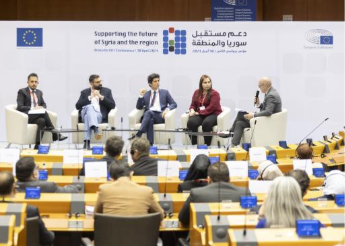
The IIIM participated in the EU organized ‘Day of Dialogue’, held for the first time in Damascus. This edition focused on Syrian civil society in the country and empowering them to play an active role in a peaceful and inclusive transition.
Grounding Work in Victim and Survivor Priorities
The IIIM held its fourth victim and survivor consultation in Geneva. Participants provided guidance on priority areas for future work, reinforcing the IIIM’s commitment to ensuring that accountability processes meaningfully reflect the needs and expertise of those most affected.
Learning from Historical Evidence Archives
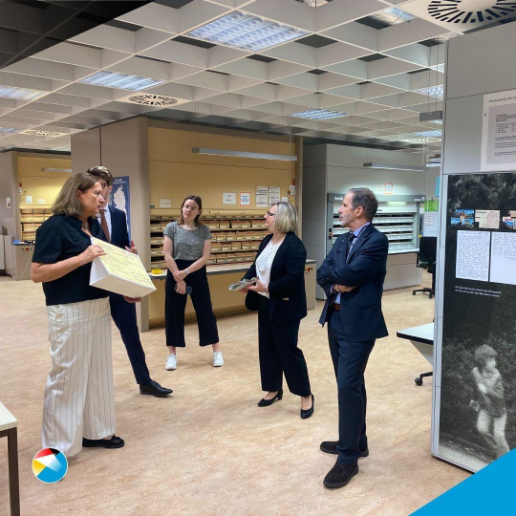
During an official visit to the Stasi Records Archive in Berlin, IIIM Head Robert Petit met with archivists to understand how Germany has preserved large-scale documentation from 1950–1990 for accountability and reconciliation purposes. The visit offered valuable insights for long-term evidence management and access in the Syrian context.
The IIIM’s Detention Report now available in Arabic
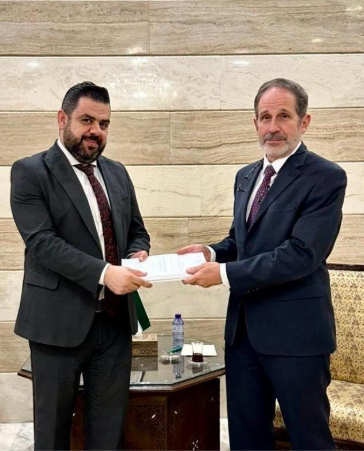
In Damascus during meetings with Syria’s authorities, including the Minister of Justice and the National Commissions for Transitional Justice and Missing Persons, IIIM Head, Robert Petit, provided copies of the public redacted Arabic Detention Report.
“The Syrian Government Detention System as a Tool of Violent Repression” is a IIIM report prepared as part of its work to support current and future justice opportunities for core international crimes.
A redacted version was made publicly available in English last year, and is now available in Arabic for victims/survivors to access in support of broader justice efforts.
The Report analyses the widespread and systematic commission of torture, ill treatment and related violations across more than 100 detention facilities, drawing on over 300 interviews with detention survivors, the Caesar files, medical forensic evidence, the Syrian Government’s own documentation, expert reports, and other evidence collected under the IIIM’s mandate.
Download the public version of the report and accompanying material in Arabic and English here.
Strengthening Accountability for Chemical Weapons Use
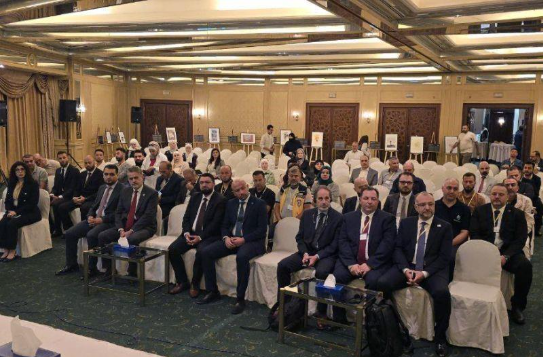
The Head of the IIIM participated in a panel at the Third Syrian Civil Society International Conference on Chemical Weapons in Damascus. Titled “Justice and Accountability for Chemical Weapons Use in Syria – A Renewed Hope for Action After 13 Years of Impunity“, the conference renewed calls for accountability as a cornerstone of Syria’s future. Mr. Petit emphasized that the IIIM’s mandate to focus on individual criminal responsibility, is uniquely placed to assist in accountability for these crimes.
The IIIM has been working on a dedicated line of inquiry on unlawful attacks, including chemical weapons, and opened two related casefiles. One of the casefiles involves conventional and chemical attacks in March and April 2017, including the sarin attack in Khan Shaykhun.
Building Open Source Investigation Capacity
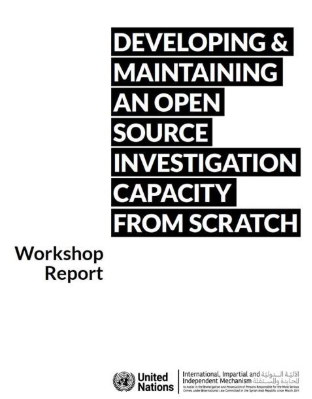
The ability to use online and public information for investigations is a valuable skill in international justice and accountability. While many individuals and groups already engage in this work, organizations often face challenges in knowing how to build the right processes with the right teams. Start-ups and institutions also need to develop these capabilities from the ground up, adding another layer of complexity. To support these efforts, the IIIM hosted a closed workshop focused on overcoming challenges and sharing approaches for building and maintaining skilled and capable open source teams.
A report of the workshop is now available on our website:
https://iiim.un.org/wp-content/uploads/2025/07/Open-Source-Workshop-Report.pdf
Latest Justice Developments with IIIM Support
Below is a selection of proceedings where disclosure of IIIM support has been authorized. The IIIM’s work supports jurisdictions globally and those listed are only a fraction of the cases the IIIM contributes to. Many additional cases remain confidential for investigative or legal reasons.
The IIIM provides support, including through the following forms of assistance:
- Information and evidence.
- Analytical products.
- Legal analysis.
- Providing testimonial evidence at trial.
- Investigative activities.
- Witness engagement.
- Geolocation reports
BELGIUM
- First Belgian Trial for Core International Crimes Committed in Syria – November 13, 2025 – Brussels Assize Court: Conviction in absentia of Sammy Djedou for genocide and crimes against humanity against Êzîdî victims and sentence of life imprisonment. This marks Belgium’s first trial related to core international crimes committed in Syria and the first time the Brussels Assize Court has ruled on crimes carried out by ISIL against the Êzîdî community.
SWEDEN
- First ever Genocide Conviction Through Child Transfer – November 11, 2025 – Svea Court of Appeal: Conviction of Lina Ishaq for genocide (including through forcible transfer of children), crimes against humanity, and war crimes against nine Êzîdî victims, including children and 12-years sentence upheld on appeal. This is the first ever conviction handed down for genocide through transfer of children from one group to another. The judgment (available in Arabic) reveals the systematic suppression of the Êzîdî entity through restrictions on language, religion and forced conversion.
- October 29, 2025 – Svea Court of Appeal: Life sentence pronounced in July 2025 against Osama Krayem for grave war crimes (murder of Jordanian pilot) and terrorism upheld on appeal.
- October 20, 2025 – Solna District Court: Start of the trial of Mahmoud Sweidan for war crimes committed in 2012 and 2013 in Yarmouk as a member of former regime-affiliated armed militia Free Palestine Movement.
GERMANY
- November 17, 2025– Stuttgart Higher Regional Court: Khalil A. and Faiz Al S. convicted of membership in a foreign terrorist organization (ISIL) for crimes committed in Deir-Ezzor between 2016 and 2017. Each sentenced to 6 years imprisonment.
- October 1, 2025– Düsseldorf Higher Regional Court : Ossama A. convicted of membership in a foreign terrorist organization (ISIL) and war crimes against property in Al Abed. Sentenced to 5 years imprisonment.
- September 18, 2025– Düsseldorf Higher Regional Court: Mohammad A. and Asmael K. convicted of membership in a foreign terrorist organization which they joined in 2013 in southern Damascus. Mohammad A. assumed a leadership position overseeing a checkpoint in the Al-Asali district of southern Damascus, while Asmael K. served as a combatant in a specialized unit reportedly responsible for carrying out executions. Sentenced to seven and six years in prison, respectively, and acquitted of war crimes.
FRANCE
- December 4, 2025 – Paris Judicial Court: Indictment and pre-trial detention of Malik N. on charges of crimes against humanity for his role in crimes committed against detainees in the detention facility of General Intelligence Branch 285.
- November 4, 2025 – Paris Criminal Court: Trial commenced against French multinational Lafarge SA (and several former senior executives) for financing terrorism through transfer of funds to armed groups including ISIL, al-Nusra Front, and Ahrar al-Sham during 2013-2014. This is France’s first corporate trial for terrorism financing.
- October 2025 – Paris Judicial Court: Scheduling of the in absentia criminal trial before the Paris Assize Court between 16 and 20 March 2026 of French national Sabri Essid for complicity in genocide and crimes against humanity.
- September 2, 2025 – Paris Judicial Court: Arrest warrants issued for Bashar al-Assad and six former high-ranking officials for complicity in war crimes and crimes against humanity related to the 22 February 2012 bombing of a press center in Homs, killing French photographer Rémi Ochlik and U.S. journalist Marie Colvin and causing the injury of other journalists.
- July 29, 2025 – Paris Judicial Court: Arrest warrant issued for Bashar al-Assad on charges of complicity in crimes against humanity and war crimes related to the 2013 chemical attacks in Douma and Eastern Ghouta.
- July 8, 2025 – Paris Assize Court: Order to stand trial issued for French national Sonia Mejri before the Assize Court for crimes committed against the Êzîdî community, including genocide for the enslavement and mistreatment of an Êzîdî minor girl in Syria, and membership into a terrorist organization (ISIL).
USA
- Civil Case Accountability – Use of IIIM Detention Report – August 8, 2025: U.S. District Court for the District of Columbia: In Mzaik v. Syria, the U.S. District Court for the District of Columbia found the Assad regime responsible for the torture of Obada Mzaik endured during his detention at the Air Force Intelligence Branch in 2012.The IIIM’s Detention Report was submitted as part of the evidence in support of the motion for default judgement. A written judgement in the case is pending.
NETHERLANDS
- August 27, 2025 – The Hague Court of Appeal: The Hague Court of Appeal rejected the appeal filed by Mustafa Aldahoudi, a senior member of pro-government militia Liwa al-Quds, against his conviction for crimes against humanity (unlawful deprivation of liberty and torture) and participation as a leader in a criminal organization of which the object is to commit war crimes and crimes against humanity. The Court increased his sentence to 13 years’ imprisonment.
Earlier 2025 Proceedings
GERMANY
- June 16, 2025: Frankfurt Higher Regional Court convicted Alaa Mousa, former military doctor, to life imprisonment for war crimes and crimes against humanity for having tortured, sexually abused, and killed detainees in a military hospital in Homs and in a military intelligence prison between 2011 and 2012.
- June 3, 2025: Stuttgart Higher Regional Court convicted Ammar A. (Hezbollah militia member in Busra Al Sham) of murder and torture as crimes against humanity (2012-2013) and sentenced him to life imprisonment.
FRANCE
- January 20, 2025: Arrest warrant issued against former Syrian President Bashar al-Assad for complicity in attacks against the civilian population and injury to life as war crimes for his responsibility in unlawful attacks conducted in Daraa in June 2017 that led to the death of French-Syrian citizen Salah Abou Nabout.
- May 28, 2025: Paris Assize Court convicted Jaysh al-Islam former spokesperson Majdi Nema to 10 years’ imprisonment for complicity in war crimes (child soldier recruitment).
SWEDEN
- February 2025: Stockholm District Court convicted Lina Naina Ishaq for genocide, crimes against humanity, and war crimes against Êzîdî victims (conviction upheld on appeal in November 2025).
The IIIM’s Inclusive Justice Process
Implementing a victim/survivor centered approach (VSCA), informed directly by the perspectives of victims/survivors (V/S), remains at the core of IIIM’s work.
This mean engaging with those impacted by crimes as essential participants contributing to the IIIM’s work and playing a role in shaping justice and accountability priorities.
While it had been part of the IIIM’s process to consult with victims/survivors since inception, in 2022, the IIIM formalised this with its first official victim/survivor-centred consultation. The meeting focused on detention crimes with participating victims/survivors providing clear recommendations for IIIM priorities.
These were not received as abstract suggestions. They became concrete operational priorities, captured in an outcome document, that were integrated into our Detention Report and ongoing investigations.
The Inclusive Justice Checklist
To ensure consistent implementation, the IIIM developed an internal “inclusive justice checklist” that is applied to every analytical project.
At Project Start:
- Review victim/survivor association outcome documents for expressed priorities.
- Consider intersectional factors (gender, age, religion, disability, displacement).
- Identify how structural discrimination drives violations and compounds harms.
During Evidence Assessment:
- Identify materials reflecting experiences of women, girls, men, boys, and LGBTQ+ individuals.
- Assess evidence regarding children and youth across different age groups.
- Flag information relevant to missing persons work.
- Tailor collections and investigations to fill identified gaps.
In Analysis:
- Disaggregate data by sex, age, religious group, political affiliation, ethnicity.
- Examine whether inferences can be drawn from the evidence regarding discriminatory targeting considering all aspects of a violation (arrest, detention, interrogation, and prosecution).
- Analyse long-term impacts including gendered consequences post-release.
Victims’ and survivors’ perspectives are built in as a starting point for the IIIM’s work on any analytical project. The IIIM’s Detention Report exemplifies this approach.
The Detention Report
On 6 December 2024, the IIIM published its Detention Report analysing systematic torture across more than 100 Syrian government detention facilities.
Two days later, the regime fell.
The Report’s detailed facility mapping, including geocoordinates, presented the scale of the system that had operated largely out of sight for more than a decade. The unredacted version of the Detention Report has been made available to support the proceedings before the International Court of Justice initiated by the Netherlands and Canada.
The report, applying international legal standards, demonstrates that torture and ill-treatment in Syria were:
– Widespread
– Systematic
– Driven by state policy of repression by all means.
The Mzaik Case: Just twelve days after Assad’s fall, former detainee Obada Mzaik filed a motion with the U.S. District Court in Washington D.C. seeking judgment against Syria for torture in the Assad regime’s detention centers.
The public version of the Detention Report was extensively referenced to support the claims as part of Exhibit A, including to establish:
- The former Syrian government’s strategy to suppress perceived opponents
- The central role of intelligence agencies in widespread detention and torture
- Specific torture methods used at the Air Force Intelligence branch in Mezzeh where Mr. Mzaik was held
- Crimes against children and gender-based violence
- Long-term physical and psychological harm suffered by survivors
- The impact of enforced disappearance on families
Mr. Mzaik stated he filed the case “to seek justice for all the Syrians who have been victims of Assad’s prisons.”
The release of the Arabic version in September 2025 is a critical step to facilitate broader justice objectives and contribute to ongoing accountability efforts
Read the Detention Report and accompanying material here (Arabic here)
Frequently Asked Questions
A: Post-conflict transitional processes require careful navigation of legal, security and institutional consideration. Discussions with the Syrian authorities are progressing in order to establish a framework that best complements the existing Syrian-led initiatives while leveraging the IIIM’s unique mandate and capabilities. Throughout this period, the IIIM’s work supporting investigations and prosecutions across international jurisdiction continues uninterrupted, while also maintaining regular engagement in Damascus.
A: A property is any logical evidence unit we receive, a hard drive, document stack, witness interview, or file transfer. Not all become preservations. We rigorously review each to eliminate duplicates, remove non-evidentiary materials, resolve technical issues, and verify chain of custody. Only evidence meeting criminal court standards becomes a preservation, stored securely with multiple backups and periodic integrity audits.
A: Our mandate is to support jurisdictions that meet international standards of fair and independent judicial processes, and that do not apply the death penalty to the crimes being tried. Evidence preservation ensures continuity, materials collected today can support prosecutions years from now, whether in national courts abroad, future Syrian courts, or international mechanisms.
A: We support requests for assistance from worldwide jurisdictions that meet our criteria. Many remain confidential for investigative reasons or because the jurisdictions have not granted disclosure permission. Publicly disclosed cases represent only a portion of the assistance we provide.
For more FAQs visit here LINK
Read the full FAQs here.
Glossary of Key Terms
- Evidence Property: One logical unit of evidence (hard drive, document stack, interview, file transfer) registered in the IIIM system, can range from a single page to entire servers with millions of documents.
- Preservation: Verified evidence unit that passed quality control and is stored in the secure, backed-up central repository with integrity auditing. Meets criminal court evidentiary standards.
- Central Repository: The IIIM’s secure digital archive of evidence, fully replicated across multiple backup systems and periodically audited for integrity.
- Request for Assistance (RFA): Formal requests from judicial authorities for IIIM information, evidence, analytical products, or legal support for investigations, prosecutions, and trials.
- Universal Jurisdiction: Legal principle allowing countries to prosecute serious international crimes (war crimes, crimes against humanity, genocide) regardless of where they were committed or the nationality of the perpetrators or victims.
- Beyond Reasonable Doubt: The highest evidentiary standard required in criminal courts, evidence must be so convincing no reasonable alternative explanation exists than the defendant’s guilt.
- Victim/Survivor-Centered Approach (VSCA): Methodology placing victims and survivors as active participants shaping accountability processes, ensuring their priorities, perspectives, and expertise inform investigation and analysis work.
- Analytical Products: Specialized reports, geolocation analysis, or legal briefs synthesizing large volumes of evidence into comprehensive
Read full glossary here