

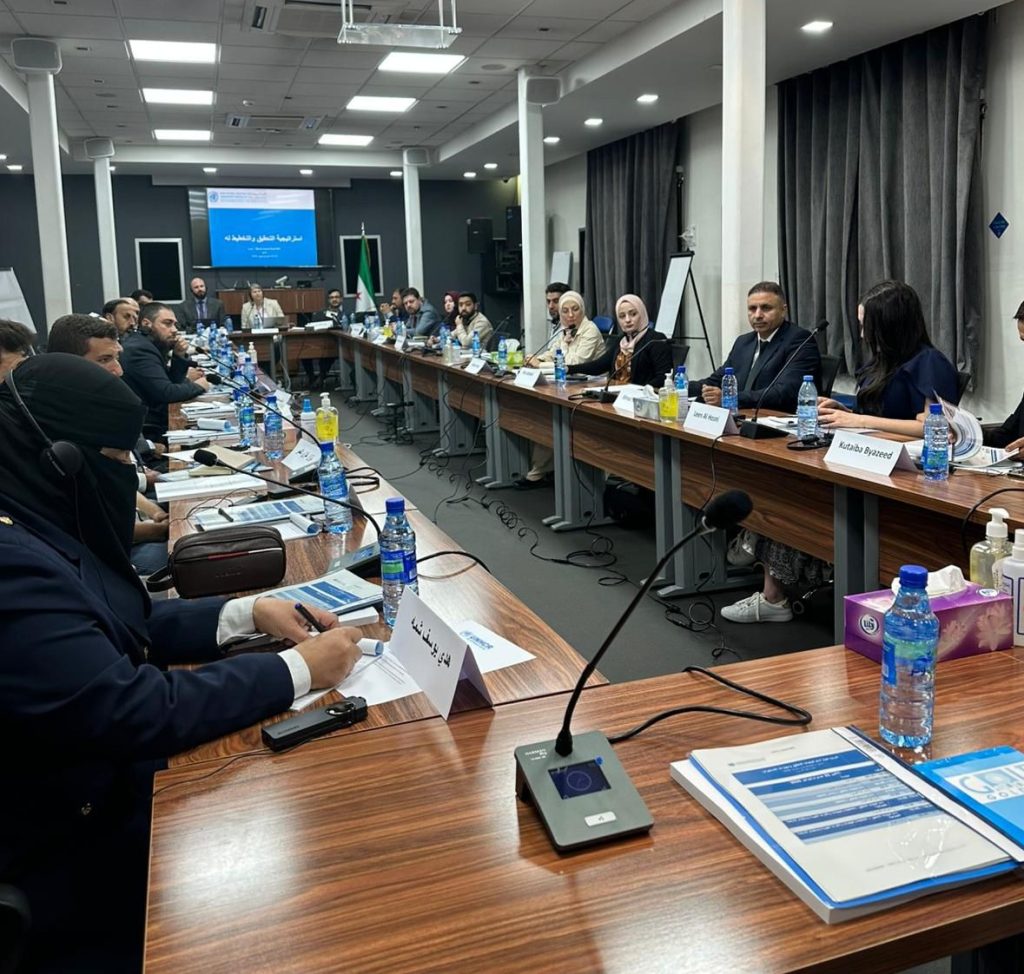
Damascus, 22–23 June 2026 – The International, Impartial and Independent Mechanism for Syria (IIIM Syria) delivered a training on investigation strategy and interviewing skills attended by representatives from the National Commission for Transitional Justice (NCTJ), the Ministry of Justice (MOJ), and the Ministry of Interior (MOI).
On the first day, participants focused on investigative planning and organisation in criminal investigations involving large volumes of documentary, testimonial and crime scene evidence. Through practical exercises, they examined approaches to developing structured investigation plans and prioritising investigative activities.
The second day focused on interviewing victims, survivors, insiders, and suspects. Participants explored how interview planning and a structured interview process can help investigators obtain reliable and relevant information while supporting the progression of criminal investigations and future criminal proceedings.
This training forms part of the IIIM’s ongoing support for Syrian-led accountability efforts to investigate serious international crimes by equipping participants with practical approaches to investigative planning and interviewing.

IIIM and NCTJ convene in Damascus to explore collaborative opportunities

Damascus, 10 May – The International, Impartial and Independent Mechanism for Syria (IIIM- Syria) convened with the Syrian National Commission for Transitional Justice (NCTJ) at the commission’s headquarters to explore avenues for future collaboration and to deepen joint efforts in advancing justice and accountability in Syria. This meeting placed particular emphasis on information management, including the collection, consolidation, preservation, and secure storage of evidence and information.
The IIIM expresses its appreciation to the NCTJ for hosting this in-depth exchange and reaffirms its commitment to continued collaboration with the commission.
IIIM Holds First In-Country Workshop in Syria on Information Management

Damascus, 11 May – The International, Impartial and Independent Mechanism for Syria (IIIM‑Syria) convened its first in-country technical workshop in Syria on information management, marking a significant milestone in its engagement with Syrian national stakeholders and institutions, and its support for Syrian‑led justice and accountability efforts.
Held with the support of the Government of the United Kingdom, the workshop provided a platform for in-depth, practical discussions on the effective management of large volumes of information relevant to accountability and justice processes. Sessions focused on key aspects of information management, including identification, collection, preservation, processing, analysis, and secure handling of digital data. Particular attention was given to best practices for organizing and safeguarding information in a manner that supports future Syrian justice and accountability efforts.
The workshop brought together representatives from several Syrian ministries, alongside technical and information management experts. Participants included officials and designated technical focal points from relevant Syrian ministries, national commissions, and other entities with data, archives, and information management responsibilities, including the Ministries of Justice, Interior, and Foreign Affairs, the National Commission on Transitional Justice, the Independent Institution on Missing Persons in the Syrian Arab Republic (IIMP), Mnemonic, and Truth Guardians.
As IIIM’s first in-country technical engagement in Syria, the workshop reaffirmed the Mechanism’s readiness to support Syrian national institutions in strengthening their capacity to preserve and manage information and materials relevant to future justice processes. IIIM hopes this workshop will serve as the first in a series of sustained and in-depth engagements, including future trainings, and technical exchanges on priority issues essential to advancing accountability in Syria.
The IIIM expresses its gratitude to the Government of the United Kingdom for its sponsorship, and to the Syrian authorities and participating institutions for their cooperation and support in making this workshop possible, in furtherance of justice and accountability efforts in Syria.
IIIM Reaches Milestone of 1,000 Sharing Activities

Geneva, 01 May– The International, Impartial and Independent Mechanism for Syria (IIIM – Syria) today announced that it has shared with international justice actors information and evidence to support justice efforts and to help clarify the fate of missing persons on more than 1,000 separate occasions since becoming operational in 2018. This milestone reflects the sustained demand for the IIIM’s expertise and specialized resources in support of Syria‑related investigations and prosecutions conducted internationally, as well as the important role it plays in helping the search for missing persons.
IIIM Head Robert Petit highlighted the significance of this achievement, stating: “Behind the milestone of 1,000 sharing activities are 269 distinct investigations and prosecutions supported, from 16 extraterritorial jurisdictions. It is a clear measure of the continuing demand for our work and the opportunities for contributing to the urgent efforts to clarify the fate of the missing.”
The IIIM is currently engaged in discussions on a cooperation framework with the Syrian authorities that will govern its collaboration with Syria, including on sharing and technical assistance. Mr Petit emphasized that, while the IIIM has not yet shared any evidence with Syria, the IIIM “very much looks forward to a framework that would pave the way for substantive collaboration in support of accountability efforts in Syria, guided by a shared commitment to inclusive, impartial justice and respect for due process.”
The materials shared by the IIIM span a wide spectrum, from interviews and official documentation issued by government authorities or armed groups including ISIL, to videos, photographs, social media extracts, analytical or geolocation reports, and legal briefs, among others. This breadth reflects the depth and variety of the evidence collected and preserved by the IIIM.
These materials are shared with extraterritorial law-enforcement, prosecutorial, and judicial authorities engaged in the investigation and prosecution of core international crimes committed in Syria in accordance with the IIIM’s terms of reference. Source consent underpins every IIIM sharing activity: no materials the IIIM holds are ever shared without the prior consent of those who provided them.
The IIIM also brings its expertise into courtrooms in-person, providing expert testimony that draws on years of specialized investigative and analytical work to support proceedings at the highest level. The materials shared directly support ongoing investigations and prosecution efforts, including the 40 judicial proceedings for which the IIIM has been authorized to publicly disclose its involvement, though its contributions extend to many more cases still confidential at this stage.
General Assembly Briefing on Syria: IIIM Head Calls for Sustained Support to Advance Accountability

New York ,15 April 2026 – Addressing the United Nations General Assembly, ASG Robert Petit, Head of the International, Impartial and Independent Mechanism (IIIM-Syria), underscored that Syria now faces a crucial opportunity to advance accountability and transitional justice, one year after the events of 8 December 2024 that marked the end of decades of authoritarian rule.
He pointed to tangible progress on the ground. Newly established National Commissions for Transitional Justice and Missing Persons have begun their work. At the same time, the Ministries of Justice and Interior have apprehended thousands of alleged perpetrators. He cautioned, however, that these developments remain partial and that significant challenges persist.
In parallel, he added that the Mechanism’s operational role has expanded alongside a growing demand for its support. As of 31 January 2026, the IIIM received 544 requests for assistance from 17 competent jurisdictions, including 107 new requests during the reporting period. This reflects continued reliance on its analytical work, central repository, and operational support.
This expanding workload has coincided with a major shift in the Mechanism’s engagement inside Syria:
- For the first time since its establishment, the IIIM has been authorized to undertake operational investigative work on Syrian territory, including access to a detention facility linked to serious violations
- Monthly missions have enabled direct engagement with ministries and national bodies
- Authorization has been received to deploy an evidence officer in Damascus.
Amid these developments, ASG Petit emphasized that victims and survivors remain central to all accountability efforts. He added “As our engagement inside Syria has expanded, one constant has guided our work: victims and survivors. Throughout our activities in 2025 civil society organizations and victims and survivors expressed the same message: that justice must not be selective, nor evolve into a process that recognizes the suffering of some while overlooking the suffering of others.”

ASG Petit called on Member States to provide sustained support in order to meet rising demands. The Mechanism’s ability to respond to growing accountability needs in Syria and across competent jurisdictions depends on adequate resources, technical cooperation, and political backing.
Without sufficient staffing and funding, the IIIM cannot carry out its evidence collection, preservation, and analytical work effectively or respond in a timely manner to requests linked to ongoing investigations and prosecutions.
He emphasized: “Syria enters a new and uncertain phase of transition, one constant remains: justice cannot take root without sustained commitment, adequate resources, and structures capable of recognizing all victims and all crimes. For this to succeed, continued engagement is needed from Syrian institutions, civil society, victims and survivors and from Member States”.
Member States welcomed the efforts of the IIIM and the progress it has made and reaffirmed their support for the Mechanism in addressing resource constraints and operational challenges.
Watch the speech delivered by the Head of the Mechanism here
Historic Meeting: IIIM Roundtable on Extraterritorial Prosecution of Crimes in Syria

On 12–13 January 2026, the IIIM welcomed Syrian justice actors alongsideinternational prosecutors and investigators, in Geneva, for two days of focused discussions on accountability for crimes committed by the former Syrian regime.
The historic nature of the meetings which included Syria’s Deputy Minister of Justice for Judicial Affairs, the Public Prosecutor, members of the judiciary and of the National Commission for Transitional Justice would have been inconceivable before the fall of the Assad regime and marked another milestone for advancing justice and accountability for Syria’s victims and survivors.
The meetings took place at a pivotal moment for Syria, marked by early efforts to address past crimes alongside the establishment of new justice pathways. Discussions reflected a growing recognition that accountability efforts inside and outside Syria are increasingly interconnected.
The first day, the IIIM brought together representatives of the Syrian Ministry of Justice, the Ministry of Foreign Affairs, and the National Commission for Transitional Justice to update them on the IIIM’s ongoing support to jurisdictions investigating and prosecuting core international crimes, lessons learnt from international judicial cooperation and to hear their perspectives on justice and accountability processes.
The following day, the IIIM convened a roundtable where non-Syrian war crimes prosecutors and investigators from several national jurisdictions joined the Syrian participants. The discussions included participants sharing the operational realities of extraterritorial proceedings, the challenges faced by justice actors inside and outside Syria and explored practical strategies for overcoming barriers to cooperation, including through the IIIM’s mandate.
Head of the IIIM, Robert Petit, noted that “We are entering a new phase in which domestic Syrian efforts and ongoing extraterritorial proceedings coexist and increasingly depend on one another. This coexistence creates opportunities.”
Across both days, the discussions demonstrated constructive engagement, a shared understanding of the priorities and interest in further engagement to advance justice and accountability efforts.


Head of IIIM Interview with Swissinfo

In a recent interview with SWI swissinfo.ch, ASG Robert Petit, Head of the IIIM, reflected on the accountability process in Syria and highlighted the essential role played by Syrians in advancing efforts toward justice.
As he noted, Syrians themselves “have been some of the most active, committed, politically savvy, competent advocates for themselves, for accountability, and some of the best documenters of atrocity crimes that the world has seen.”
ASG Petit also pointed to the significant legal and institutional challenges that continue to affect prospects for accountability and justice in Syria.
Copyright © 2026 by Helen James
First Evidence Collection Conducted in Syria

In cooperation with the Syrian Government, the International, Impartial and Independent Mechanism (IIIM) has conducted its first evidence collection in the Syrian Arab Republic.
The IIIM team was given access to visit and document the Al-Khatib detention facility, formerly operated by General Intelligence Branch 251. For years, survivors and former detainees have provided testimonies describing the widespread and systematic use of torture, cruel treatment, and inhumane conditions of detention at this facility.
The site still bears visible traces of the atrocities committed within its walls. The operation, conducted with the support of the Syrian Ministries of Interior and Foreign Affairs, will contribute to ongoing and future judicial proceedings aimed at holding perpetrators accountable for their crimes.
By preserving sites of abuse and rigorously collecting evidence, the IIIM and Syrian authorities aim to support justice processes, upholding victims’ rights, and ensuring that grave violations are neither erased nor forgotten.
Dutch Newspaper Trouw Interview with IIIM Deputy Head

30 January 2026– In an interview with Trouw, IIIM Deputy Head, Michelle Jarvis, discussed why gender perspectives matter in international criminal law and accountability work.
Ms. Jarvis stated that a gender perspective helps investigators uncover harms and patterns that standard approaches can overlook. She referred to Bosnia and Srebrenica to show how violence can affect gender groups differently. She also noted that legal practice has progressed in treating sexual violence as a core international crime, however stigma continues to affect what survivors feel able to disclose.
From her work on Syria, Ms. Jarvis stated that some harms remain under-recorded. She noted that women and girls often had less access to medical treatment and suffered later from health complications after chemical weapons attacks. She added that early documentation drew mainly on statements from men which meant gendered consequences were not fully captured.
Read the full article here.
Copyrights of the photo: Brechtje Rood
Statement by Mr. Robert Petit, Head of the International, Impartial and Independent Mechanism (IIIM)
Geneva, 8 December 2025
One year after the historic events of December 8, 2024, Syria is in a markedly different place. The fall of Assad’s regime opened space for justice efforts that were long obstructed.
Over the past year, we have intensified efforts to preserve, consolidate and analyse information that is central to current and future proceedings. Our central repository of information and evidence continues to grow, strengthening the foundation needed to move comprehensive accountability forward.
Since the start of our work, we have supported 256 investigations and received more than 530 requests for assistance from jurisdictions worldwide.
The establishment this year of Syria’s National Commissions for Transitional Justice and Missing Persons marks a significant and welcome development, although many crucial questions remain about the shape and scope of transitional justice in Syria. Through our engagement with the Commissioners in Damascus and Geneva, we follow their emerging priorities and stand ready to offer technical assistance and expertise. Discussions with the Syrian authorities are ongoing to determine how we can best support their work to help define and deliver justice for Syria.
For the IIIM, our responsibility remains the same: to help ensure that those responsible for the gravest crimes committed in Syria are held to account. Syria’s tireless civil society organizations and victim and survivor associations continue to inspire and guide our work. Their documentation, insights and advocacy remain essential to ensuring that accountability responds to the harms they and countless others have endured.
There are of course, numerous challenges facing Syria, including building the trust of the Syrian people through fair and effective justice responses to crimes committed since December 8.
However, the opportunities before us today did not exist a year ago. Turning them into concrete outcomes will require sustained commitment and cooperation from all actors, Syrian and international alike.
My team and I will continue to deliver on the IIIM mandate, providing assistance to jurisdictions investigating and prosecuting those suspected of international crimes committed since 2011. We are also ready to support Syrians as they shape and advance their own transitional justice processes.
This first anniversary is a milestone in a journey that will span years. However, for justice to endure, it must be inclusive and grounded in meticulous evidence and due process, with meaningful participation of victims and survivors. Accomplishing that will take time, trust and cooperation, but it is an objective that is now achievable. My team and I feel privileged to be part of the journey.
Thank you for your continued support.
Robert Petit
Head, International, Impartial and Independent Mechanism